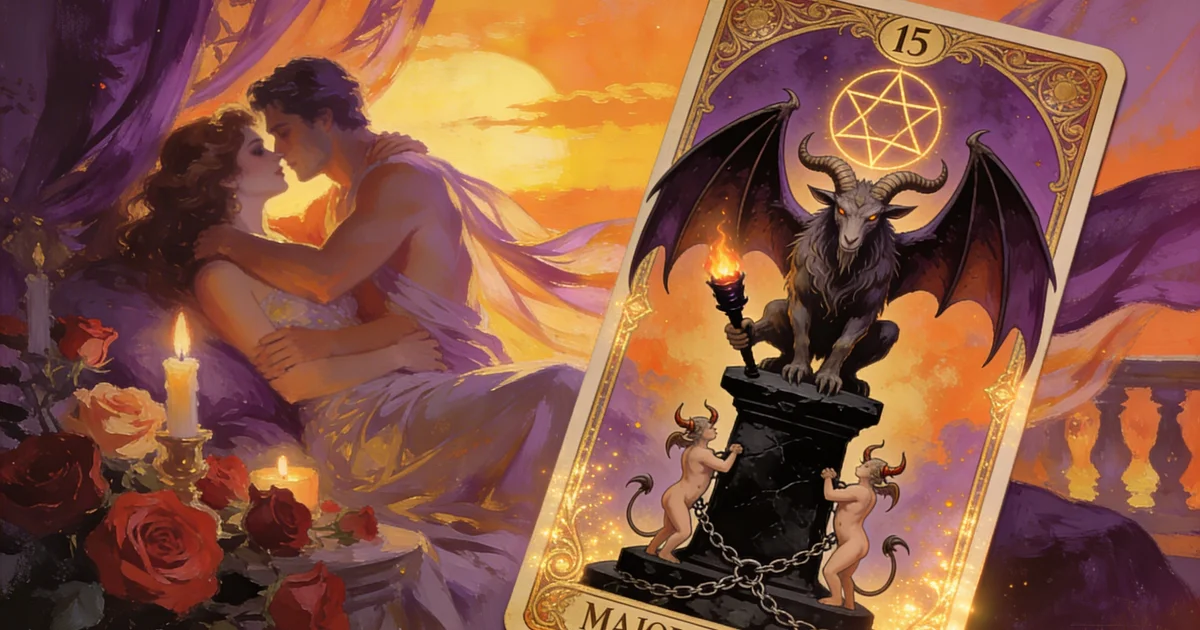
When the The Devil card appears in a love tarot reading, its presence can cause unease. This major arcana, number 15, does not announce literal evil, but rather illuminates the bonds, intense desires, and power dynamics that can exist in our most intimate relationships. In the context of a yes or no question, its message is complex and deeply reflective, inviting us to look beyond the surface of our connections.
Meaning of The Devil in Love
The energy of The Devil in love symbolizes the ties that bind us, often willingly. It represents intense passions, toxic attachments, emotional dependencies, and temptations that can cloud our judgment. This card suggests a relationship where desire, possessiveness, or fear of loss plays a central role. It is not necessarily a "bad" relationship, but one where there is a strong component of magnetic attraction, sometimes at the expense of individual freedom or personal growth.
The card's symbolism is key: the chained figures, with loose manacles, indicate that the bonds are frequently self-imposed or consented to. In love, this can translate to staying in a dynamic out of comfort, fear of loneliness, addiction to emotional intensity, or a limiting belief that "this is all I deserve." The Devil card confronts us with our shadows and asks: What are you willing to accept in the name of love?
On the other hand, The Devil can also point to a very powerful, almost irresistible physical and chemical attraction. In this sense, the card speaks of carnal desires and an intense earthly connection. The tarot's message here is to observe whether this passion is liberating and part of a healthy whole, or if it has become the sole pillar of the relationship, chaining people to a cycle of desire and possession that stifles other aspects of the bond.
Upright Interpretation
When The Devil appears upright in a love consultation, its energy manifests clearly and powerfully. Here are some of its key meanings:
- Bonds and Dependence: The card suggests a relationship where there is strong emotional dependence, codependency, or a feeling of being "trapped." The ties may be difficult to break, even if one is aware they are unhealthy.
- Intense Passion and Desire: Indicates a very powerful, almost magnetic physical and sexual attraction. This passion can be the central axis of the relationship, eclipsing other components like friendship or mutual support.
- Materialism and Possession: May reflect dynamics of control, extreme jealousy, or a view of love as possession ("you are mine"). It can also signal that material factors (money, status, comfort) are an important reason for staying in the bond.
- Temptation and Choices: This card's energy invites you to examine temptations. Perhaps there is a temptation to return to an ex out of habit, to start a relationship knowing it's not for the best, or to give in to immediate desires that compromise long-term well-being.
- Self-Deception and Limitations: The Devil points to the chains we place on ourselves: limiting beliefs about love, fears that paralyze us, or the acceptance of less than we deserve for fear of not finding something better.
Reversed Interpretation
With The Devil reversed, the energy begins to be released, though the process can be challenging. The tarot's message orients towards breaking bonds and gaining awareness.
- Release from Bonds: Indicates an active process of breaking free from toxic dependencies, harmful habits in the relationship, or limiting thought patterns. It's a sign that work is being done to loosen the chains.
- Rejection of Temptation: Suggests the ability to say "no" to a situation, person, or pattern that does not serve emotional well-being. There is a flash of clarity and willpower to choose a different path.
- Confronting the Shadow: The reversed card encourages looking directly at the darker or more complicated aspects of the relationship or oneself in order to heal them. It's a call to brutal honesty.
- Reclaiming Personal Power: Signals the beginning of the end of a cycle of victimization or submission. It involves taking the reins of one's own emotional life and starting to prioritize inner freedom.
- Warning of Incomplete Liberation: Sometimes, The Devil reversed can indicate that, although one is trying to break free from something, the emotional bonds or habits are so deep that there is a risk of relapse. Liberation requires conscious and sustained effort.
Practical Advice
The appearance of The Devil is a powerful call to introspection and personal responsibility in the realm of love. It's not about looking for an external culprit, but about examining your own participation in the relationship's dynamics.
- Ask about the chains: Write honestly: What ties me to this person or situation? Is it fear, desire, comfort, financial dependence, or a belief about myself? Identifying the "link" is the first step.
- Examine the balance: Evaluate if your relationship has a balance between passion, emotional intimacy, and conscious commitment. Does one of these elements dominate and chain the others?
- Reclaim your power: Remember the symbolism of the loose manacles. What small step can you take today to loosen one of those self-imposed bonds? It could be setting a boundary, expressing a need, or simply acknowledging your right to be free.
- Seek the shadow with compassion: Instead of judging your intense desires or attachments, observe them with curiosity. What deep need are they trying to satisfy? Understanding this with self-love is more liberating than simple repression.
Is It a Yes or a No?
The Devil's answer to a yes or no question in love is deeply conditional and cannot be absolute. The card itself is not a definitive "yes" or "no," but a "it depends on your awareness and your choices."
- It may lean towards a "NO" if your question is related to starting a new relationship based mainly on overwhelming physical attraction, rekindling a past bond that was toxic or dependent, or expecting a dynamic of control and possession to change on its own. In these cases, the Devil's energy warns that proceeding without conscious work will likely reinforce the chains.
- It may lean towards a "YES" if your question is related to facing the shadows of an existing relationship to transform it, to recognizing and taking responsibility for your own attachments, or to the possibility of an intense passion that, only if handled with awareness and mutual respect, can be part of a deep connection. The "yes" here is tied to growth through challenge.
In essence, The Devil transforms your "yes or no?" question into a more powerful one: "Are you choosing from your freedom or from your bonds?". The true answer emerges from your honest reflection on this.
Final Reflection
The Devil in love is the mirror that shows us the parts of ourselves we would rather not see: our most ingrained fears, our most intense desires, and the chains we mistake for love. Its appearance is not a condemnation, but a radical invitation to liberation. It reminds us that the most sophisticated prisons are those whose keys we hold in our hands, but have forgotten how to use. By facing this shadow with courage and compassion, we do not deny love, but rather redefine its essence, transforming it from a possession that limits into a bond that, paradoxically, makes us freer.
"The Devil's chains are not forged in iron, but in the fear of our own light. True love does not bind; it unleashes the courage to be who we truly are."